
by Jeff Conant, Deputy Director, Forests, Food and Finance, Friends of the Earth. Published on Oct 15,2026.
i.
Last November as many of my colleagues and comrades headed to the Brazilian city of Belem at the mouth of the Amazon to fight for climate justice at the United Nations Framework Convention on Climate Change — UNCOP30 — I spent a week in Brazil’s Cerrado region, in a little-trafficked corner of Bahia state. Not much of a tourist destination, the Cerrado is a huge area the size of Western Europe which in recent decades has earned a sobering nickname: the Kingdom of Soy. I was there to deliver a report to local community leaders illuminating the role of a major U.S. pension fund manager in buying up land in an area that, local agrarian communities believed, rightly belonged to them. The latest in a series of reports on landgrabs in the Cerrado researched and published in Portuguese by the Brazilian Network for Social Justice and Human Rights and adapted in English by my organization, Friends of the Earth U.S., this was our first report to focus on western Bahia — one of the regions in Brazil with the fastest growing industrial soy plantations, and consequently a hotspot for accelerating deforestation.
*
Arriving by plane to Barreiras, an agribusiness hub of fertilizer companies, feed stores, and tractor supply outlets, I was welcomed by a warm-spirited, energetic man named Abner, who runs logistics for 10envolvimento, a local NGO. The organization had grown out of the Catholic Church to help agrarian communities gain collective title to their lands. Over the next few days, Abner explained, we would drive through the basins of the Rio Grande, the Corrente and the Carinhanha rivers and meet with spokespeople for traditional communities who’d been expelled from the plateaus to the lowland valleys. We’d be traveling entirely within the bounds of the area known as “the ring of soy.”
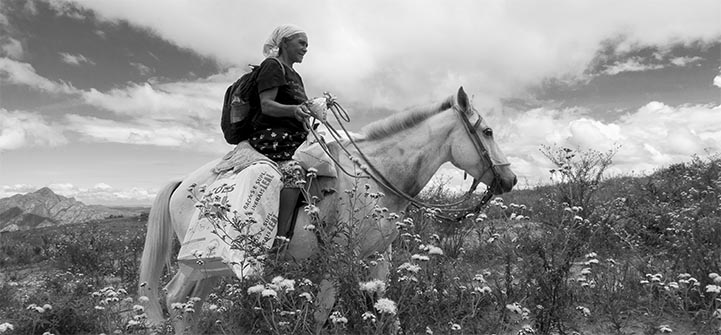
The topography here is wide expanses of flat scrubland punctuated by sudden plateaus called chapadas, not unlike the rolling hill country of West Texas, dressed in a green chaparral vegetation, spindly low trees, buriti palms, euphorbia, cactus. Though its home to some 5% of the world’s species, the Cerrado is not overwhelmingly dense with life like a rainforest or striking to the eye like the cathedral redwoods of California. But it teems with biodiversity: 12,000 plant species, over 800 tree species, about the same number of distinct types of birds, and mammals found nowhere else on earth: maned wolves, giant anteaters, agoutis and the onca-pintada, the largest jaguar in the Americas. But in this whole vast expanse, Abner explained, the explosive growth of monoculture plantations had confined the remaining native Cerrado vegetation to the protected river valleys and lowlands — the same areas occupied by the remaining traditional communities.
Projecting a map on the wall, Abner pointed out dark streaks of green amidst wide fields of brown: “These are the river valleys where the communities remain,” he explained.
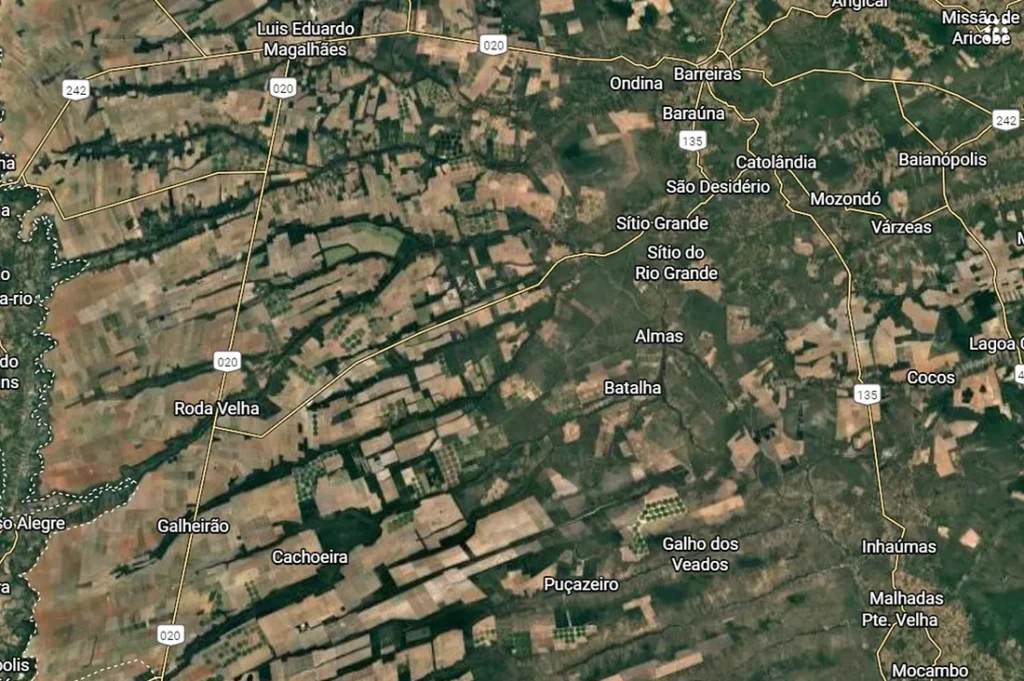
Before much of the Cerrado became a global provider of cotton, soy and other industrial crops it was known by ecologists as Brazil’s “birthplace of waters” for its critical role in feeding the nation’s rivers. Underneath the land here is a vast subterranean reservoir, the Urucuia Aquifer. When agronomists and hydrologists came — “from your country, from Nebraska,” Abner pointed out wryly — “they judged that the Urucuia could never be depleted.” So the companies they worked for set about drilling wells 500 meters deep and installing massive center-pivot irrigation systems.
“Now,” said Abner, “the whole basin is drying up.”
A comprehensive geological survey published in 2023 showed that the aquifer underlying much of the Cerrado is being depleted faster than it can recover. The São Francisco river which forms here before crossing 505 municipalities in six states, no longer reaches the Atlantic.
Since 2021 the Urucuia has lost a volume of water equal to seven-and-a-half cubic miles — far more than it can recharge. The clear cause is industrial irrigation, combined with rapid deforestation. In the last 40 years, more than half of the Cerrado has been plowed under and converted into industrial plantations. But local communities don’t need geological surveys to tell them what’s happening — everyone I would speak to in the coming days repeated what they lived everyday: our streams are dry, our cattle are thin, our Cerrado is losing its life.
ii.
In 2024 when a UK-based group called Earthsight came to investigate cotton production, Abner gathered water samples from a tributary of the Rio de Janeiro that courses through an ecological preserve. All eight samples found high levels of atrazine and glyphosate. The Earthsight report, Fashion Crimes, traced cotton from western Bahia’s industrial estates through the sweatshops of Asia to fast fashion brands H&M and Zara: vast stretches of Cerrado vegetation wiped out for global fashion.
Earthsight’s approach was similar to what I was doing here, only instead of following the flow of cotton, I was following the flow of money — specifically, looking at the role of one U.S.-based financial firm in buying up tracts of land through joint ventures and complex subsidiary arrangements, and dedicating it to industrial crop production.
The retirement fund manager TIAA manages $1.3 trillion for academics, non-profits, and knowledge professionals and is one of the largest investors in fossil fuels and agribusiness, with an estimated $33 billion invested across both sectors. TIAA’s subsidiary Nuveen Natural Capital is a land-focused asset manager which has bought up over 2-and-a-half million acres of land across 11 countries, making it the seventh largest institutional farmland owner in the world. Its land portfolio in Brazil, where it owns or manages over 1 million acres, holds some of its most contentious acquisitions.
Based on years of scrutiny, researchers and journalists have alleged that TIAA, through a company called Radar, which is a joint venture between Nuveen and Cosan, Brazil’s largest sugar company, has bought multiple properties across the Cerrado. Some of its properties, researchers and journalists allege, appear to have been purchased from sellers who had acquired the lands illegally; legal inquiries have examined whether the firm, which is based in New York, bypassed laws limiting foreign ownership of Brazilian farmland. TIAA has thoroughly rejected this claim and all other claims of wrongdoing: “In August 2025, the technical division of INCRA — the National Institute of Colonization and Agrarian Reform in Brazil — conducted a detailed review of Radar’s corporate control structure and issued a formal decision confirming its legality, expressly recognizing that the company is under Brazilian control and not subject to foreign ownership restrictions under Brazilian law,” a Nuveen representative told me in an email.
In a region dominated by agribusiness behemoths like Cargill, Bunge, ADM, SLC Agricola, TIAA is far from the largest or most problematic corporate actor. But as a company whose main business is managing retirement funds, TIAA presents a unique case that illuminates the problems generated when financial firms treat land as an investment asset.
In 2022, nearly 300 TIAA clients filed a formal complaint with the UN-sponsored Principles for Responsible Investment (PRI) initiative, in which TIAA is a prominent member. The complaint alleged that its substantial investments in fossil fuels and deforestation violate TIAA’s climate pledges and commitment to the body’s six Principles for Responsible Investment. The complaint was dismissed, but the attention it brought, along with over a dozen faculty senate resolutions at U.S. universities calling on TIAA to divest from dirty enterprises, may have played a role in TIAA’s increasing efforts to demonstrate social responsibility. The firm’s publicity materials show a proud commitment to making farmland ownership sustainable: “We believe that our farmland investments can help to meet global demand for food, while encouraging sustainable practices to be good stewards of the environment over the long term.”
This year Brazil will export 110 million tons of soybeans, mostly to China. Some 90 percent of the soy grown in the Cerrado goes there, likely including soy grown by SLC Agricola which regularly leases TIAA’s properties. Contrary to what you might think, this massive flow of soy is not for tofu and soy sauce, but to feed pigs in China’s industrial feed lots. This is the global demand for food that TIAA is helping meet — and it drives some of the most destructive land use practices on Earth.
Decades of attempts to halt the expansion of the soy industry have been largely a one-step-forward-two-steps back affair. A case in point is the Amazon Soy Moratorium — an agreement forged two decades ago between environmental groups, Brazilian authorities, agribusiness and western consumer goods companies to refrain from purchasing soy grown on land in the Amazon that was deforested after 2006. The result has been hailed as one of the most effective environmental achievements of recent decades: researchers estimate that an area of rainforest the size of Ireland would have been lost to soy farms in Brazil without the moratorium and related conservation efforts.
Nonetheless, the agreement had one unfortunate side effect: the companies that had been wiping out the Amazon for soy simply moved next door, as it were, and effectively turned the Cerrado into a sacrifice zone. By 2024, after twenty years of global investment in the Kingdom of Soy, the deforestation rate in the Cerrado had surpassed that in the Amazon.
Curiously, it was shortly after the 2006 Amazon Soy Moratorium went into effect that global financiers began eyeing land in the Cerrado. After the 2008 financial crisis and the resulting collapse of the U.S. housing market, TIAA, along with many other financial corporations, needed a secure place to park their funds, and they identified farmland as a sound investment. With the soy industry pushing into the Cerrado, land values increased; financial firms saw the trend and began investing. The more land was bought by foreign firms, the higher the prices went. The resulting boom in rural real estate in turn stimulated business deals between investors like Nuveen Natural Capital (TIAA’s land acquisition arm) and the Harvard Management Company and major agribusiness interests like SLC Agricola, Cosan and Bunge. Growth begets growth, business feeds business, and soon enough, there was almost no Cerrado left for the people who had scratched out a livelihood here for centuries.
To make matters worse, while the threats to the Cerrado continue unabated, the Amazon Soy Moratorium itself has now been successfully dismantled by Brazil’s powerful agribusiness lobby, with leading global soy traders abandoning it in droves.
iii.
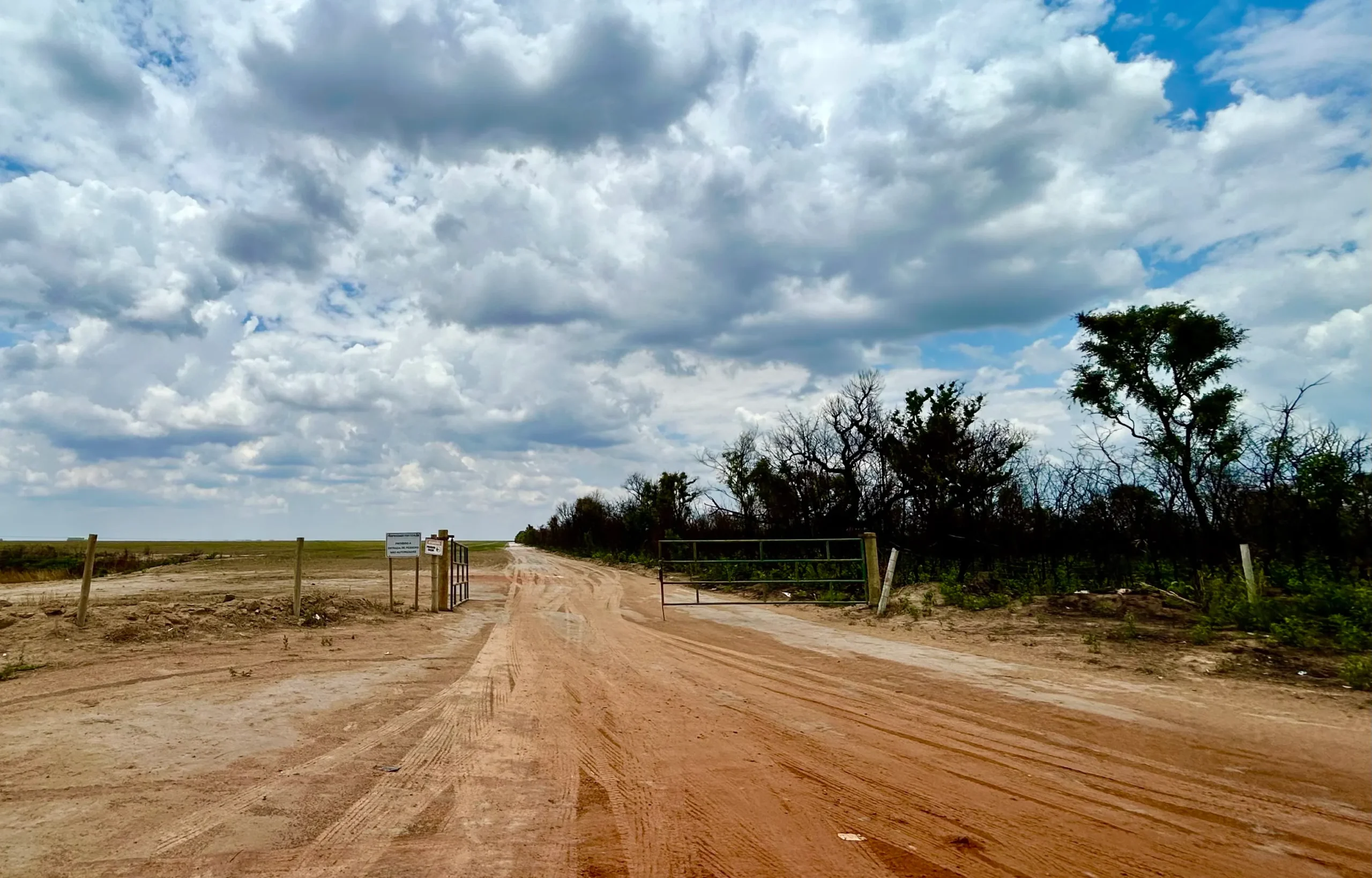
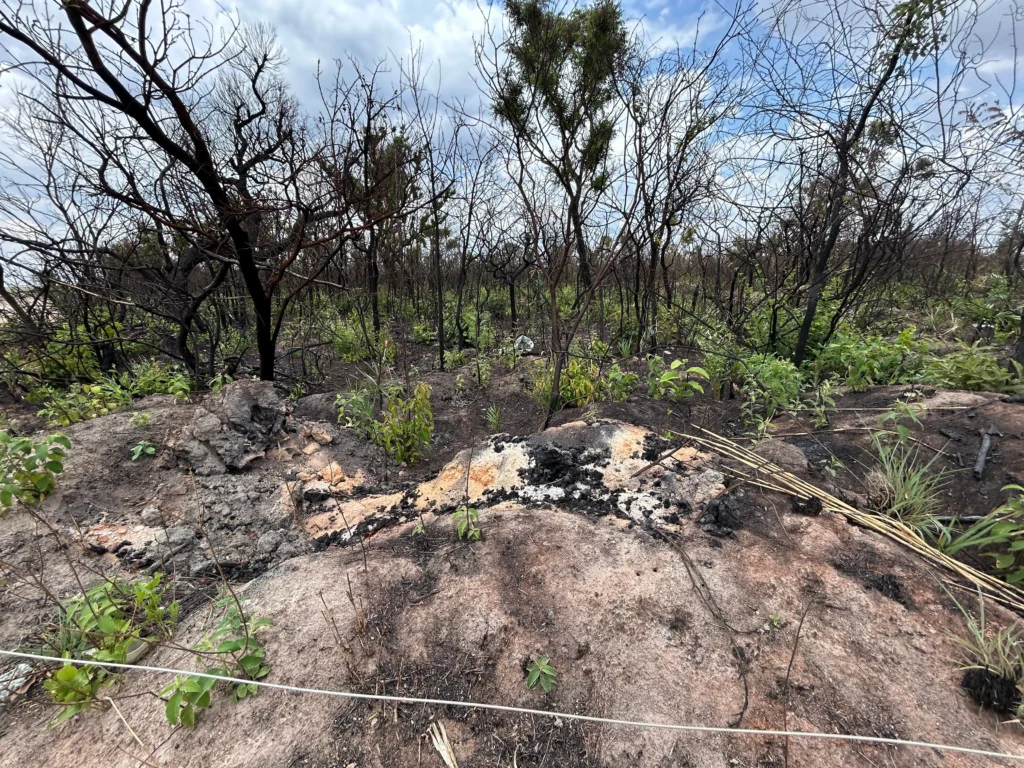
From Barreiras we spent a day driving around the ring of soy. Near an industrial crossroads called Luis Eduardo Magalheas we drove a long dirt road alongside properties called Bananal Farm and Rio de Janeiro Farm, partly owned by TIAA. What I saw was industrial farm after industrial farm, all brown, barren and dry: no people, no animals, no crops, no life. As in much of the U.S. heartland, the word “farm” is deceptive: the Rio de Janeiro Farm, for example, covers roughly 67 square miles — the size of Washington D.C. In November the view was especially bleak: usually, I was told, the rain would have started by now. At any other time of year the landscape might be greener, lush with soy and cotton. But, for the industrial plantations as for the peasant farmers, planting had been delayed due to drought.
We traveled several hours south to Correntina — a lively little city with the beautiful Corrente River flowing right through the center of town — and then down long dusty roads to meet with peasant farmers whose land abutted one of TIAA’s legal reserves, a place called Fazenda Felicidade.
A wiry man name Dernevaldo walked me along the barbed wire fence that, he said, marked the boundary beyond which lands were no longer in the hands of the local communities.
“Our territory was much larger in the time of our ancestors,” Dernevaldo explained. “Our grandparents, great-grandparents, great-great-grandparents — they pastured their animals all the way to the border of Goiás; that was all the territory of our people. With the arrival of agribusiness, what’s left for us is just a small piece. What’s left of the Cerrado in Correntina is just 3 percent. And in those 3 percent, this area of ours is being illegally seized by companies we’ve never heard of. They simply arrive, start building fences, start deforesting, and expelling us. It’s the law of the strong expelling the weak, right? And so we are in this situation, suffering, facing gunmen, heavily armed people in the service of these farms, these companies.”
Though his words described harsh conditions, Dernevaldo was clearly a man in love with the land.
“Pastoralism is native here in the Cerrado. We want the Cerrado the way it is, with the native vegetation, the animals grazing on this grass. We didn’t plant it here. We don’t want to clear the land to plant grass; that’s not what we’re interested in. Our interest here is to see a pequi tree like this one, flowering, producing fruit for our family, and for other people who come here to pick the fruit and eat it. These are natural fruits; nature produces them for everyone. So we don’t have any interest here in income, profit, selling, or making money. What we defend here are our customs and traditions.”
“We are also descendants of Black and Indigenous people, so our people have the tradition of collecting roots of medicinal plants for both people and animals. We are children of this land, we are native to this place, we know how to do things here. If they take us away from here, if they dry up our river, where will we go? We have nowhere to go. We’ll have to go live under a bridge. Is that what the government wants? Is that what the big businessmen, the people with money, most of whom are here illegally occupying these territories, buying or illegally seizing land and selling it in bad faith to others — this commercialization they’re doing — is that what they want? They can go somewhere else, but where will we, the natives of this place, go? We are family farmers, small farmers, and we have this great role in society of producing healthy, natural food to put on the table of all Brazilians. So this is a huge loss for us.”
As we talked, I reflected on my own role here, publishing report after report documenting in great detail the ways in which financial speculation and the expansion of the soy industry are driving land grabbing and deforestation. But Dernevaldo’s words, and the looks on his face as we walked the dry Cerrado scrub, tell the story in ways no set of data points can match.
When the time came to part, I had one more question.
“Your cattle,” I said, “They feed off the native vegetation?”
“Yes.”
“It’s true what I was told, that you keep about one cow for every ten hectares of land?”
“In the best of times, yes.”